Is It Legal to Download Pinterest Videos?
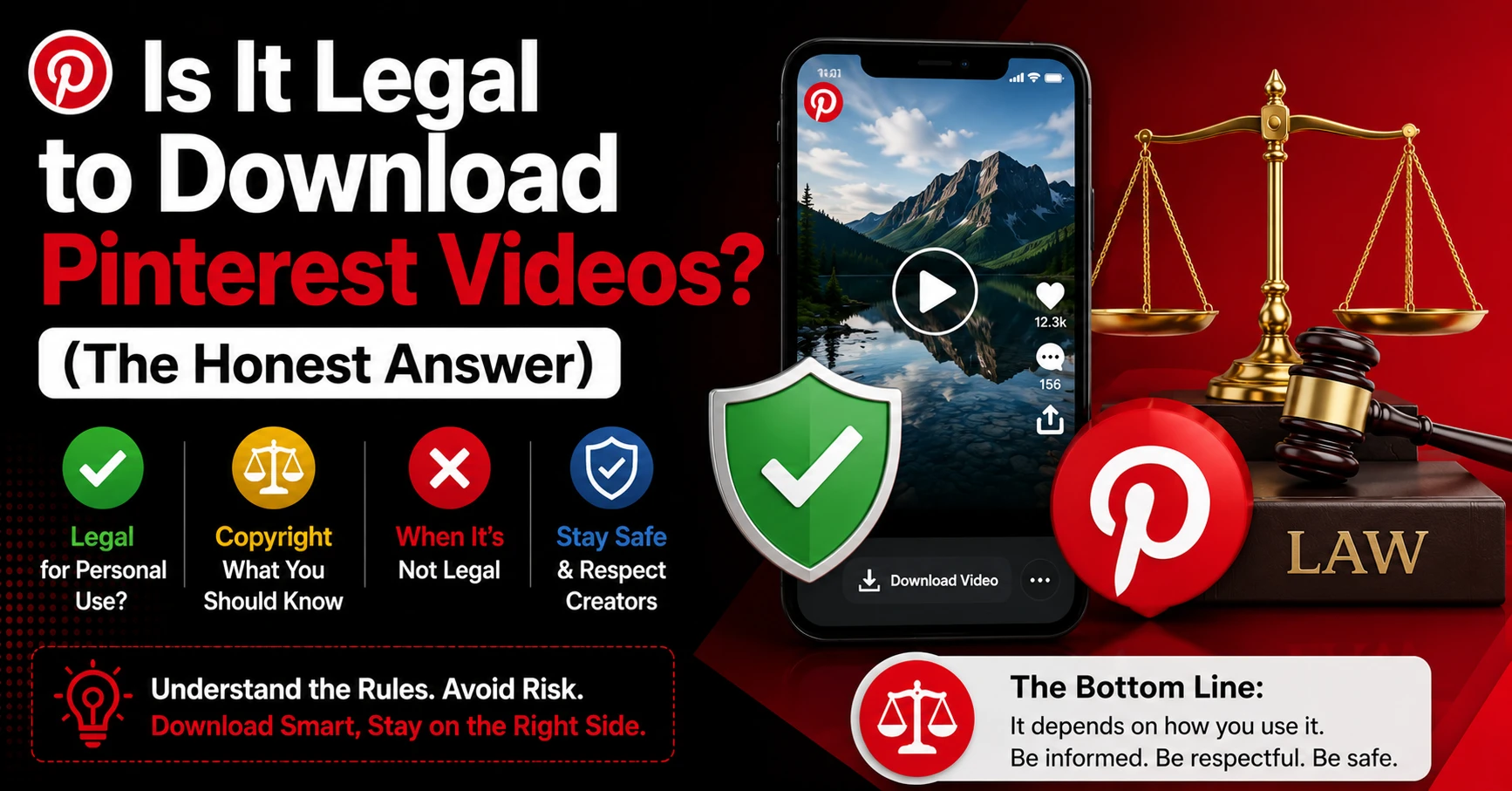
This is one of those questions where most websites either dodge the answer completely or give you a legal-sounding wall of text that doesn't actually help. So let's skip all of that and just be direct.
The short answer is: it depends on what you do with the video after you download it.
Downloading a Pinterest video for personal use — saving it to your phone so you can reference it later, building a mood board, watching it offline — sits in a legally gray area that is widely practiced, rarely enforced, and generally considered acceptable under fair use principles in most countries.
Using that same downloaded video to make money, posting it as your own content, or distributing it without the creator's permission is a different story. That can create real legal problems.
This guide breaks down exactly where the legal lines are, what Pinterest's own rules say, how copyright law applies to downloaded videos, and what you can actually do without worrying about it. We'll also cover the practical reality of enforcement — because there's a significant gap between what's technically against the rules and what actually results in consequences.
What Does Pinterest Actually Say About Downloading Videos?
Let's start with Pinterest's own position, because it's more nuanced than most people realize.
Pinterest's Terms of Service
Pinterest's Terms of Service include a section that restricts automated scraping and downloading of content from their platform. Specifically, they prohibit using automated tools to access, scrape, or download content without their permission.
However — and this is important — Pinterest's ToS primarily targets commercial scraping operations, data harvesting, and bulk automated downloading at scale. Individual users downloading occasional videos for personal use are a different category, and Pinterest doesn't enforce their ToS against casual personal downloaders.
Pinterest also states that content on their platform belongs to the original creators, not to Pinterest itself. This means Pinterest's ToS tells you what you can't do on their platform, but it doesn't determine what the copyright owner allows.
Pinterest's Content Guidelines
Pinterest's Community Guidelines focus on what content can be posted to the platform. They require users to only post content they own or have rights to share. This is relevant to the uploading side of things but less directly relevant to downloading.
The practical reality is this: Pinterest has never pursued legal action against individual users for downloading content using browser-based tools for personal use. Their enforcement focus is on commercial misuse, spam, and platform manipulation — not on someone saving an aesthetic video to their camera roll.
Copyright Law and Pinterest Videos
Pinterest's Terms of Service is separate from copyright law. Even if Pinterest allowed downloading freely, copyright law would still apply. And even if Pinterest restricts downloading in their ToS, copyright law sets the outer boundaries of what rights creators actually have.
Who Owns Pinterest Videos?
When someone uploads a video to Pinterest, they retain the copyright to that content. Pinterest's ToS grants Pinterest a license to display, distribute, and promote that content on their platform — but the creator keeps ownership.
This means every video you see on Pinterest is technically copyrighted material belonging to whoever created it. Downloading it without the creator's permission could theoretically constitute copyright infringement — but whether it actually does depends on how you use it.
Fair Use — The Key Legal Concept
In the United States, fair use is a legal doctrine that allows limited use of copyrighted material without permission under certain circumstances. The U.S. Copyright Office uses four factors to evaluate whether something qualifies as fair use:
Factor 1: Purpose and character of use Is the use commercial or non-commercial? Transformative or just copying? Personal, non-commercial use tends to favor fair use. Downloading a video to save as personal inspiration is non-commercial. Using it to make money is not.
Factor 2: Nature of the copyrighted work Creative works get stronger protection than factual ones. A professionally produced video has stronger copyright protection than a simple instructional clip, though both are protected.
Factor 3: Amount and substantiality Are you using the whole work or just a portion? Downloading a complete video is technically using the whole thing, which weighs against fair use — though personal use mitigates this.
Factor 4: Effect on the market Does your use harm the copyright owner's ability to profit from their work? Personal viewing offline has minimal market effect. Redistributing the video commercially could directly harm the creator's income.
When you download a Pinterest video to watch offline or use as personal reference, factors 1 and 4 generally favor fair use. Factors 2 and 3 are more neutral. The overall picture for personal use is generally acceptable — which is why this type of downloading is widely practiced without legal consequences.
Fair Dealing in Other Countries
If you're not in the United States, similar concepts apply under different names.
In the United Kingdom, fair dealing under the Copyright, Designs and Patents Act 1988 allows limited use of copyrighted material for private study and personal research.
In Canada, fair dealing covers private study and research under the Copyright Act. Canada's fair dealing provisions are somewhat broader than US fair use.
In Australia, the Copyright Act 1968 includes provisions for fair dealing for research and study.
In the European Union, the InfoSoc Directive allows member states to implement exceptions for private copying. Most EU countries have implemented some form of private copying exception that covers downloading content for personal use.
The specific rules vary by country, but the general principle across most jurisdictions is the same: personal, non-commercial use of copyrighted content for private viewing and reference is treated more leniently than commercial use or redistribution.
What You Can Legally Do With Downloaded Pinterest Videos
Let's get specific, because "it depends" isn't actually helpful without knowing what it depends on.
Clearly Fine
Saving for personal reference and inspiration Downloading a Pinterest video to save as inspiration for a project, mood board, or creative reference is personal use. You're not publishing it, not profiting from it, and not replacing the creator's ability to earn from their work. This is the most common reason people download Pinterest videos, and it's the most legally comfortable category.
Watching offline Downloaded a travel inspiration video to watch on a flight? A cooking tutorial to reference while you're in the kitchen without reliable WiFi? This is personal offline viewing — essentially the same as what streaming services allow with their download features.
Using in personal mood boards and presentations Using downloaded Pinterest videos in a private mood board you show to a client in a meeting — not published online, not distributed — is generally considered fair use in a professional context. You're using it as a reference tool, not copying it for distribution.
Academic research and analysis Analyzing Pinterest video content for academic research, studying design trends, or examining visual communication techniques are uses that generally fall within fair use or fair dealing provisions globally.
Gray Area
Sharing with a small group privately Sending a downloaded Pinterest video to a friend or small group through a private message is technically redistribution but at such a small scale that it's extremely unlikely to create legal issues. Most legal frameworks ignore de minimis (trivially small) infringement.
Using in internal business presentations Using a downloaded Pinterest video in an internal company presentation — shown only to employees, not published — sits in a gray area. It's not commercial in the sense of making money from the video, but it's broader than purely personal use. Most companies do this without issues, but technically it depends on the specific copyright holder's stance.
Posting short clips for commentary or critique Using a brief excerpt of a downloaded Pinterest video to comment on it, critique it, or discuss it publicly could qualify as fair use — but the shorter the clip and the more commentary you add, the stronger the fair use argument.
Clearly Not Okay
Reposting as your own content Taking someone else's Pinterest video and posting it to your own social media as if you created it is both a copyright violation and potentially a violation of moral rights (the creator's right to attribution). This is the clearest line, and it's one that creators actively enforce.
Using in commercial advertising Including a downloaded Pinterest video in a paid advertisement, promotional video, or commercial content without the creator's permission is commercial copyright infringement. This is the type of use that results in actual legal consequences.
Selling or distributing downloaded videos Selling downloaded Pinterest videos, distributing them on other platforms for commercial gain, or using them in products you sell is straightforward copyright infringement.
Claiming copyright over downloaded content Attempting to register copyright over someone else's downloaded Pinterest video or claiming ownership of it is fraud on top of copyright infringement.
What Actually Happens in Practice
There's a big gap between what's technically a legal violation and what results in actual consequences. Let's be honest about this.
Individual Personal Use — Almost Never Enforced
In the years that Pinterest has existed, there is no documented case of a copyright holder successfully suing an individual user for downloading a Pinterest video for personal use. None. The legal and practical costs of pursuing such a case far exceed any potential damages.
Copyright enforcement against individuals typically happens when the infringement is commercial — someone is making money from the stolen content — or when it's at massive scale. Personal downloads of a few videos for mood boards and inspiration don't meet either threshold.
Platform-Level Redistribution — Actively Enforced
Where enforcement does happen is when downloaded content gets redistributed on other platforms. If you download a Pinterest video and repost it on TikTok, Instagram, or YouTube without credit, the original creator can — and many do — file DMCA takedown requests.
According to data from the U.S. Copyright Office, DMCA takedown notices are filed in enormous volumes every day. Most are between rights holders and platforms, not between rights holders and individual users. But reposting someone else's content publicly puts you in a category where enforcement is much more likely.
The Attribution Question
Many Pinterest creators don't actually want you to never use their content — they want credit for it. If you want to share a Pinterest video publicly, the safest and most respectful approach is to tag or mention the original creator and link back to their Pinterest profile or the original pin.
A lot of creators actively appreciate this. It drives traffic to their original content, grows their following, and builds their brand. Asking permission before sharing is always the cleanest approach, and most creators respond positively when asked nicely.
How to Download Pinterest Videos Responsibly
If you've decided that downloading Pinterest videos for personal use is something you're comfortable with — which, given the legal reality of personal fair use, is a reasonable conclusion — here's how to do it cleanly and responsibly.
Pin Video Download fetches the original MP4 file directly from Pinterest's servers. The downloaded file is the same quality as the original upload — no re-encoding, no compression, no watermarks added.
For standard Pinterest videos, use the main Pinterest Video Downloader. For short-form Reels specifically, the Pinterest Reel Downloader handles audio merging automatically. For animated GIFs and loops, the Pinterest GIF Downloader detects the file format and downloads accordingly. For high-resolution images and photography, the Pinterest Image Downloader fetches the original full-size file.
Best Practices for Responsible Downloading
Keep it personal. Use downloaded content for your own reference, inspiration, and private projects. The further you move from personal use toward public distribution, the more the legal calculus shifts.
Credit creators when sharing. If you want to share something publicly — even just reposting it to your own Instagram Story — tag the original creator. It's respectful, it's the right thing to do, and it dramatically reduces any legal risk.
Ask permission for commercial use. If you want to use a Pinterest video in something commercial — an ad, a product, a paid presentation — reach out to the creator first. Most will either grant permission, ask for credit, or ask for a small fee. It's a much cleaner situation than hoping no one notices.
Don't redistribute at scale. Downloading one video for personal inspiration is completely different from running a channel that reposts other people's Pinterest content. The former is personal use; the latter is commercial redistribution that actively harms creators.
What About Pinterest's Own Download Feature?
Pinterest does have a limited download feature for some content — specifically for pins that creators have explicitly enabled downloads on. If a creator has turned on the download option for their pin, Pinterest provides a native download button.
When that button is available, using it is unambiguously fine — the creator has explicitly permitted downloading. The legal question only gets complicated when the native download button isn't available and you're using a third-party tool.
According to Pinterest's help documentation, when creators enable downloads, users can save those pins directly. Not all creators enable this, which is precisely why third-party download tools exist and are so widely used.
Frequently Asked Questions
Wrapping Up
The honest answer to "is it legal to download Pinterest videos" is this: for personal use, it's legally defensible in most jurisdictions, widely practiced, and essentially never enforced against individuals. For commercial use or public redistribution without permission, it's a real copyright issue that can have actual consequences.
The line isn't really about downloading. It's about what you do after.
Download for inspiration, reference, and personal projects — that's what most people are doing, and it's fine. Give credit when you share publicly. Ask permission before any commercial use. Respect creators even when the law is ambiguous.
Pin Video Download makes the technical side simple — paste the link, download the file, done. The legal and ethical side is up to you, and hopefully this guide has given you a clear picture of where the lines actually are.
Related Guides
How to Download Private Pinterest Videos
Let's get the honest answer out of the way first: if a Pinterest video is on a truly private board — one that the creator has locked down to only themselves — there is no tool, no trick, and no workaround that will let you download it. Not legitimately, anyway. But here's the thing: a…
How to Save Pinterest Videos on PC and Mac (Complete Guide 2026)
Saving Pinterest videos on a desktop should be the easiest thing in the world. You've got a full keyboard, a proper browser, a fast internet connection, and a big screen. And yet — Pinterest still doesn't give you a download button. It doesn't matter whether you're on a Windows PC or a MacBook. The experience…
Latest From Our Blog
Try Our Free Pinterest Download Tools
Need to download other media formats? Save any content from Pinterest instantly using our direct extraction tools:
Pinterest Video Downloader →
Extract and download public Pinterest videos in high-definition MP4 format.
Pinterest GIF Downloader →
Download animated GIF loops or convert them to lightweight MP4 videos.
Pinterest Image Downloader →
Save high-resolution JPG images and carousels in original HD quality.
Pinterest Reel Downloader →
Save Idea Pins and short Pinterest video stories with synced audio.